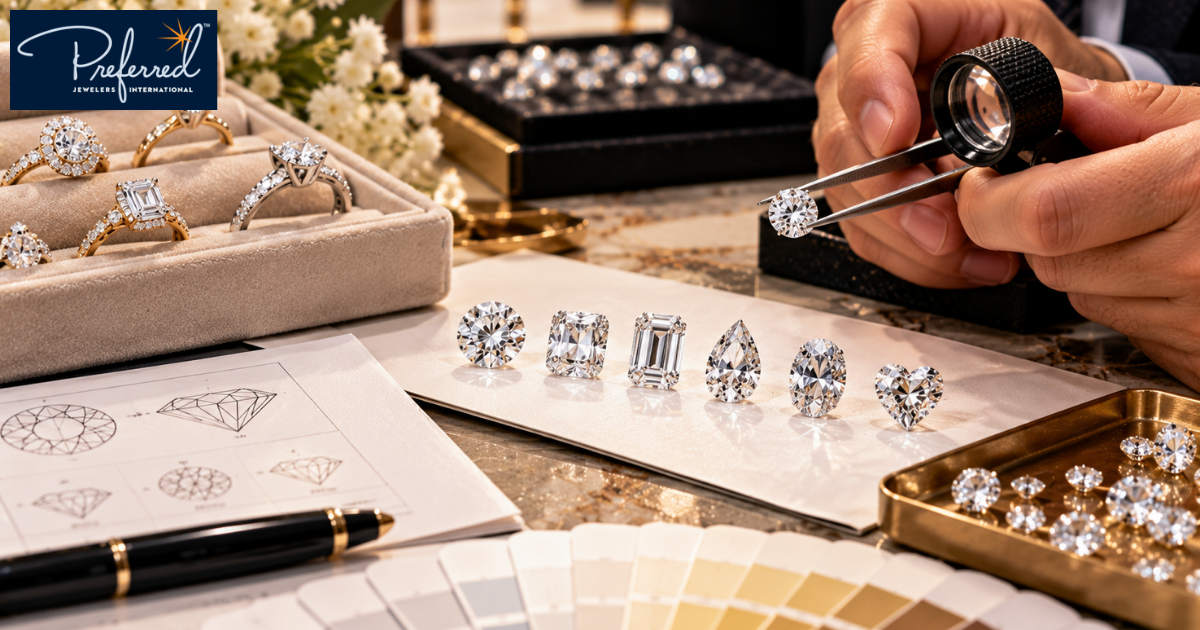
Purchasing a diamond involves more decisions than most buyers expect. Cut, color, clarity, carat, shape, certification, and budget all come into play at once, and the number of options can make the process feel genuinely overwhelming. A clear Diamond Buying Guide cuts through the noise by focusing on what matters so that buyers can make a confident, informed decision rather than a pressured one.
Understanding the 4Cs Before Buying a Diamond
Any useful Diamond Buying Guide starts with understanding the four factors that determine a diamond’s quality and value, known as the 4Cs: Cut, Color, Clarity, and Carat. Understanding these factors is essential when learning how to buy a diamond with confidence.
- Cut carries the most weight of the four. It determines how well the diamond interacts with light, producing the brilliance and spark most buyers want. A poorly cut stone will look flat regardless of how well it scores on anything else. This Diamond Buying Guide recommends paying the most attention to cut quality.
- Color runs on a scale from D, completely colorless, through Z, which shows a visible yellow or brown tint. The D to F range commands the highest prices. Diamonds in the G to J range look near colorless to the naked eye in most settings and offer better value meaningfully without a visible trade-off for most buyers.
- Clarity measures internal or external imperfections, known as inclusions and blemishes. The scale runs from Flawless to Included. At the VS2 or SI1 level, inclusions typically can't be seen without magnification. That's why spending extra for a Flawless grade often doesn't change how the diamond looks day to day.
- Carat refers to a diamond's weight, not its physical size, though heavier diamonds are generally larger. Carat weight significantly affects price, and a slight reduction in carat can often free up budget for improvements in cut or clarity.
This Diamond Buying Guide emphasises that the highest grade in every category is rarely necessary. Understanding where each C matters most helps you find a genuinely beautiful stone at a price that makes sense.
Tips for Choosing the Right Diamond
Buying a diamond starts with a budget, not a wish list. Knowing what you can spend before looking at anything else reduces pressure and narrows your options to a workable range.
Shape affects both how the diamond looks and what it costs. Round brilliant diamonds are the most popular and the most expensive. Oval, cushion, emerald, and pear shapes typically offer more visible size at the same carat weight and cost less per carat.
The best diamond buying tips consistently point to the same priority: protect cut quality above all else. A well-cut stone in a slightly lower color or clarity grade will look better in person than a higher-graded stone with a mediocre cut.
Certification is not optional. A grading report from a recognized laboratory like GIA or AGS gives an objective picture of what the stone actually is.
How to choose a diamond ultimately comes down to what you see with your own eyes rather than what a certificate says. Viewing the stone in person, or through quality video when buying online, tells you more than any specification can. This Diamond Buying Guide consistently points to cut, certification, and budget as the three factors worth settling before anything else.
Visit Valentine’s Jewelry in Dallas, Pennsylvania
If you’re in Dallas, Pennsylvania,
Valentine’s Jewelry on SR 309 has a story that starts small. About 35 years ago, Elva Valentine turned a room inside a charming antique shop into a jewelry store. Today, that same spot is a full-service jeweler where you can find everything from fashion pieces to fine designer and traditional jewelry, all in a comfortable, welcoming setting. You can browse engagement rings in halo, solitaire, classic and three stone styles, certified loose diamonds, lab grown diamond jewelry, eternity bands, men’s wedding bands, pearl jewelry, birthstone bracelets, and luxury watches. If you want something that’s truly yours, the store also does custom design. Jewelry lovers will also spot designers like Hearts on Fire, Yvel, Just Jules, and Henderson Designs, plus Schneider Design bridal jewelry, from Mark Schneider, the only bridal designer in the Smithsonian. Whether you just need a watch battery replaced or want to design the engagement ring of your dreams, the team is there to make your visit a memorable one, and they welcome shoppers from Kingston, Scranton, and Wilkes Barre too.
Conclusion
Understanding the 4Cs, setting a realistic budget, insisting on certification, and choosing based on what suits your preferences rather than simply chasing the highest grades are what lead to a genuinely good purchase. This Diamond Buying Guide makes that process feel manageable rather than overwhelming. The right diamond is simply the one that suits you best.
Frequently Asked Questions
1. How do I choose the right diamond?
Start with your budget, then decide which of the 4Cs matters most to you. Most people get the best value by prioritizing cut, since it controls how much the diamond sparkles. Always ask for a grading report from a trusted lab like GIA or AGS, and if you can, see the diamond in person before you buy.
2. What are the 4Cs of diamonds?
The 4Cs are cut, color, clarity, and carat weight. Cut is how well the diamond is shaped and polished, color is how white or colorless it looks, clarity is how many tiny marks it has, and carat is its weight. Together, they decide how a diamond looks and what it costs.
3. Which of the 4Cs is the most important?
Cut. A well-cut diamond catches light beautifully and looks brighter and larger, even if its color or clarity is a little lower. A poorly cut diamond can look dull no matter how high the other grades are.
4. What is a good color and clarity grade for a diamond?
For great value, look for color grades G to H and clarity grades VS2 to SI1. In these ranges, the diamond looks bright and clean to the naked eye, and you avoid paying extra for differences only an expert could spot. Just check that no visible flaws sit in the center of the stone.
5. How much should I spend on a diamond?
There’s no perfect number. Set a budget you’re comfortable with and let it guide your choices. A smart trick is to put more of it toward cut quality and slightly less toward color and clarity. Lab-grown diamonds are also worth a look, since they offer the same sparkle for often much less.